
Ohio Traffic Court Records
Ohio traffic court records are public documents kept by Municipal Courts and Mayor's Courts across the state. You can search for traffic cases by name, case number, or citation number through the court where the ticket was filed. Ohio has 88 counties, and each one has its own court system that handles traffic violations. Many courts use the Odyssey Case Management System or CourtView for online case searches. If you need the full case file or want to check the status of a traffic citation, you can start with the court's online search tool or call the Clerk of Courts in the right county. The records show charges, hearing dates, fines, and case outcomes.
Ohio Traffic Court Records Overview
Where to Find Ohio Traffic Court Records
Traffic court records in Ohio are kept at the court where the case was filed. Most traffic tickets go to the Municipal Court in the county where the stop took place. Ohio has Municipal Courts, County Courts, and Mayor's Courts that all handle traffic cases. The Municipal Court is where most traffic violations end up. It covers misdemeanor offenses like speeding, reckless operation, and OVI charges. The Clerk of Courts in each county keeps the official case files.
Mayor's Courts are another place where traffic records show up. Ohio is one of a few states that still has Mayor's Courts, and they handle minor traffic violations within city and village limits. Cases can be transferred to the Municipal Court if the driver asks for it. The Clerk of Courts does not always have records from Mayor's Courts, so you may need to call the city or village directly.
The Supreme Court of Ohio oversees the entire court system. It sets rules for how courts manage traffic records. Under Ohio Revised Code Section 4510.03, every court must keep a full record of every traffic case. Within seven days of a conviction or bail forfeiture, the court sends an abstract to the Bureau of Motor Vehicles. That abstract includes the driver's name, license number, the charge, the date, and the fine amount.
The Ohio Department of Public Safety runs the BMV, which keeps its own records of traffic convictions. These records tie into the points system. If you want your own driving record, you can get it through the BMV. But for the actual court case file, you need the court where the case was heard.
Note: Mayor's Court records may not be in the county court system. Contact the city or village clerk for those cases.
The Supreme Court of Ohio portal is the starting point for finding court resources and case forms across the state. You can visit their main page below.
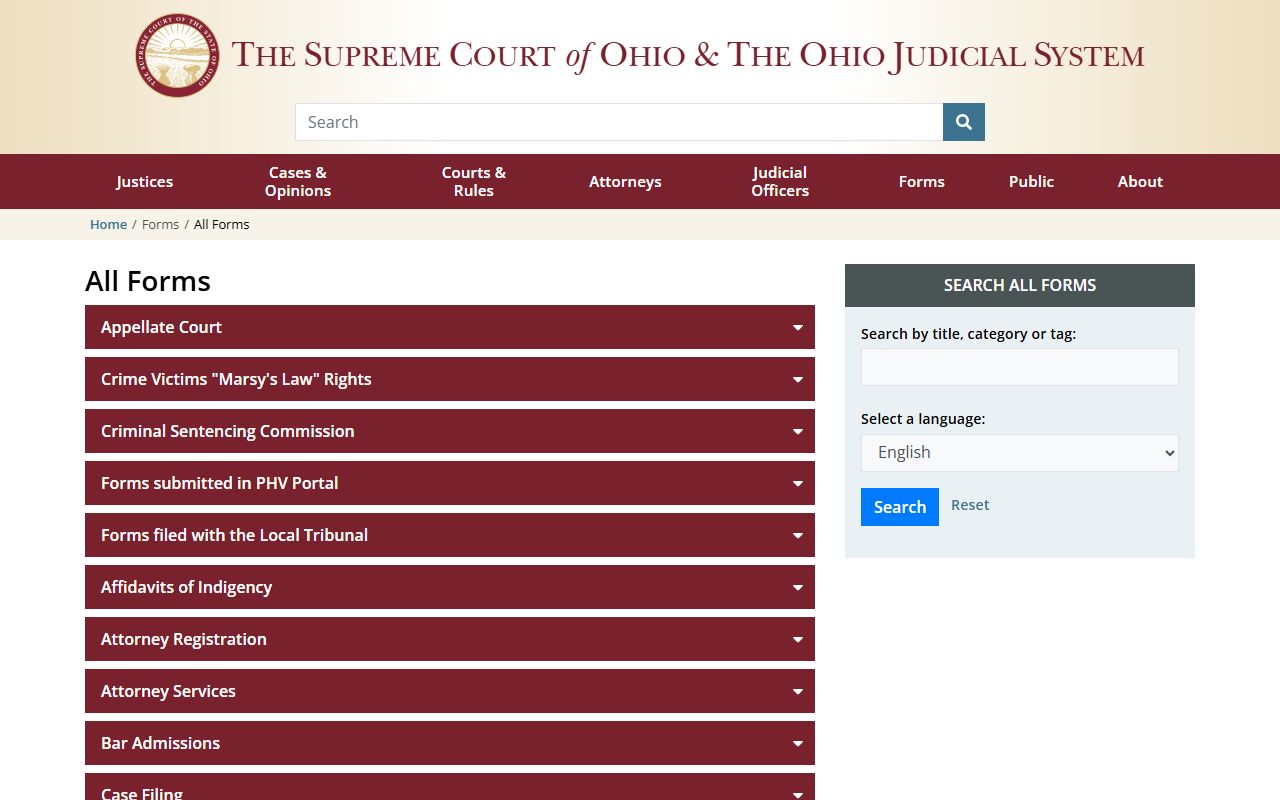
From this page, you can access case inquiry forms, court rules, and links to the Odyssey eFileOH system used by many Ohio courts.
How to Search Traffic Court Records in Ohio
Ohio gives you a few ways to search for traffic court records. The fastest option is online. Many Municipal Courts use the Odyssey Case Management System or CourtView, and both let you look up cases by name or case number for free. Not all courts have full online access, but the larger ones do. Cleveland, Columbus, Cincinnati, Toledo, Akron, and Dayton all have online search tools on their court websites.
To search online you will need at least one of these:
- Full name of the person cited
- Case number or citation number
- County where the ticket was filed
- Approximate date range of the violation
In-person searches work at any Clerk of Courts office. Walk in during business hours and ask at the window. You can search by name or case number. Staff can pull up the file and make copies. Certified copies cost more than plain ones. Each county sets its own copy fees, but most charge a small per-page rate. Some offices also take phone requests and can mail copies to you.
The eFileOH system at Odyssey eFileOH lets attorneys and self-represented parties file documents in some courts 24 hours a day. Self-represented litigants can register at the Ohio Tyler Tech portal to use the guided interview process for certain forms. The system works like tax prep software and walks you through the steps.
The Ohio Revised Code Title 45 covers all motor vehicle and traffic laws. You can search by section or keyword on the state code site.
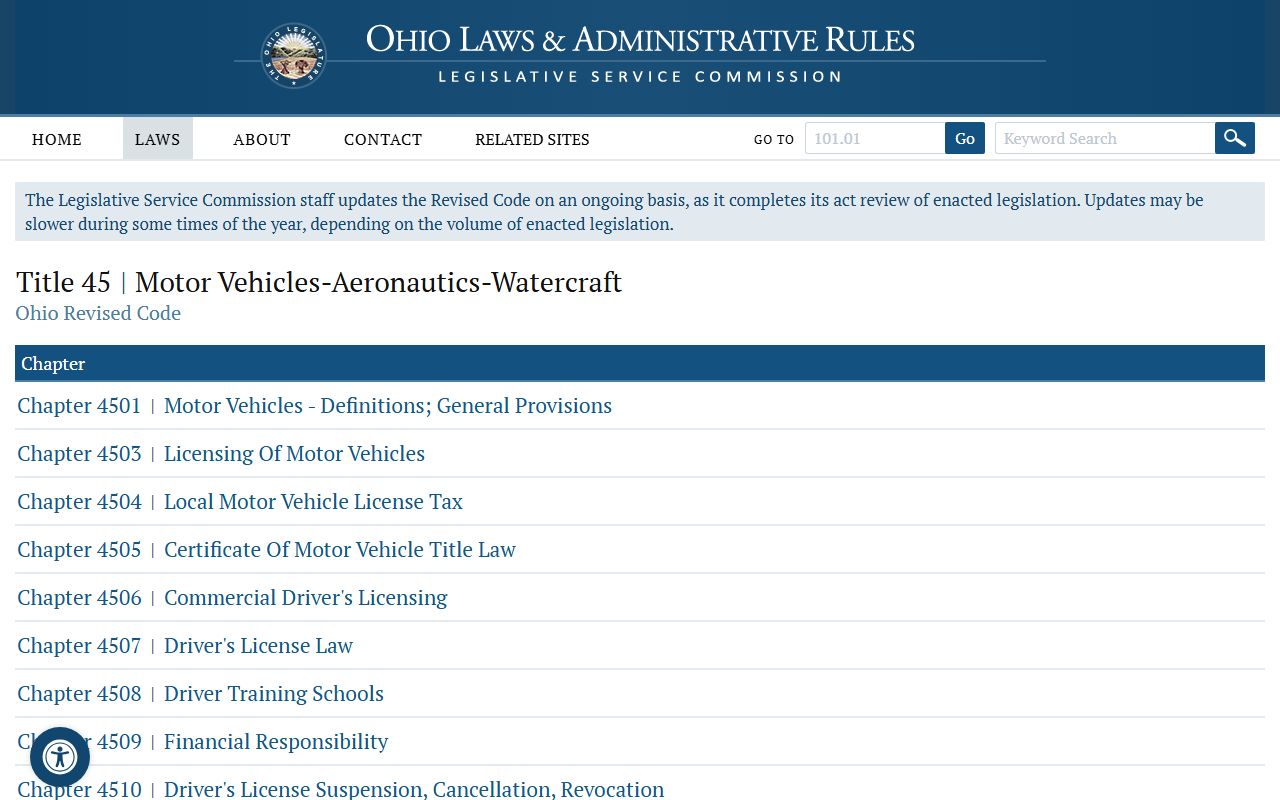
Title 45 holds everything from license rules to the full points schedule under Chapter 4510.
Ohio Traffic Court Records and the Points System
Every traffic conviction in Ohio goes on your driving record. The BMV uses a points system to track violations. Under Section 4510.036, the BMV records points within 10 days of a conviction. Courts must put the point count on the abstract they send to the BMV. The points stay on your record and add up over time.
The most serious violations carry six points. That list includes aggravated vehicular homicide, fleeing or eluding police, hit-skip accidents, and OVI with a high concentration. Reckless operation and speeding 30 or more miles over the limit get four points. Most other moving violations are worth two points. Texting while driving starts at two points for a first offense and goes up from there.
When you hit five points, the BMV sends a warning letter. At 12 points in a two-year period, your license gets a Class D suspension of six months under Chapter 4510. You have 20 days after the notice to appeal. To get your license back after a points suspension, you need to finish a remedial driving course, pass a test, and show proof of insurance. A driving course can also give you a two-point credit, but you can only do that once every three years.
Note: If you are convicted of multiple offenses from the same facts, only the highest-point offense counts on your record.
The Ohio Department of Public Safety handles driver records, license abstracts, and the BMV points system through its secure OHID portal.
You can use this portal to check your own driving record or find BMV office locations across Ohio.
Types of Ohio Traffic Court Records
Traffic cases in Ohio fall into a few groups. Criminal traffic offenses are the most serious. OVI (called DUI in some states) is a criminal offense in Ohio. So is reckless operation, vehicular assault, and vehicular homicide. These cases go to the Municipal Court or, for felonies, to the Court of Common Pleas. The case file for a criminal traffic offense includes the citation, the charging document, court appearances, plea entries, and the sentence.
Chapter 4511 of the Ohio Revised Code covers all traffic laws for motor vehicles. It defines everything from right-of-way rules to speed limits to the rules for school zones. Chapter 4549 deals with motor vehicle crimes like hit-skip and fictitious plates. These statutes set the penalties and point values for each violation.
Minor misdemeanor traffic offenses include most speeding tickets, failure to stop, and similar violations. They are still traffic court records, but the penalties are lighter. Many of these can be resolved by paying the fine without a court appearance. The court still creates a record and sends an abstract to the BMV.
Ohio Traffic Court Records and Public Access
Court records in Ohio are generally public. Traffic court records are no exception. Under Ohio Revised Code Chapter 149, public records include records kept by any public office. You do not need to give a reason for requesting records. You do not need to identify yourself. The office must make the records available promptly during regular business hours.
The Ohio Attorney General's Sunshine Laws page has tips for making a public records request and information about your rights. If a public office denies your request, they must tell you why. The Ohio Court of Claims handles complaints about denied public records access. As of April 2025, new rules require the requester to send a notice to the public office and wait three business days before filing a formal complaint. The filing fee is $25.
There are a few things that are not public in a traffic case file. Sealed records, juvenile traffic cases, and certain personal information may be restricted. But the bulk of a traffic case file is open to anyone who asks. The Section 2743.75 of the Ohio Revised Code gives the Court of Claims exclusive jurisdiction over public records complaints.
The Ohio Attorney General maintains resources on Sunshine Laws to help people understand their right to access public records including traffic court records.

Their site offers tips, training, and the Ohio Public Records Manual for both requesters and public offices.
Traffic Court Records Forms in Ohio
The Supreme Court of Ohio forms page has downloadable forms for case management, protection orders, and other court filings. While the Supreme Court does not have a single statewide traffic citation form, each Municipal Court and Mayor's Court uses forms set by local rules. Most courts post their own forms on their websites.
The Odyssey eFileOH system lets you file court documents from anywhere. You need a current email address and a valid credit card. Self-represented litigants can use the Guide and File feature for guided form completion. All documents must be in PDF format. The system works around the clock, so you don't have to wait for the clerk's office to open.
The Ohio State Highway Patrol maintains crash report records separately. If your traffic case involves an accident, the crash report is available through the Highway Patrol's online system or through a records request. These are public records and may be useful if you are contesting a traffic citation.
Ohio Traffic Court Records and License Suspension
License suspension in Ohio comes with its own set of records. Under Chapter 4510, suspensions are broken into classes. Class One is a lifetime suspension. Class Seven is up to one year. The court or the BMV can impose a suspension depending on the offense. Each suspension goes on your driving record and ties back to the traffic court case.
Limited driving privileges may be available. Under Section 4510.021, a court can grant privileges for work, school, medical appointments, court hearings, and taking your child to school. The court order spells out the exact times and places you can drive. You may also need an ignition interlock device or restricted plates. First-time OVI offenders can petition for unlimited driving privileges with an ignition interlock under Section 4510.022.
Reinstatement after a points suspension requires three things. You must complete a remedial driving course that covers driver attitude and substance abuse awareness. You must pass the driving test. And you must show proof of financial responsibility, which means insurance. The BMV handles reinstatement, but the traffic court records are the reason for the suspension in the first place.
The Ohio Revised Code Chapter 4510 lays out all suspension classes and the rules for getting your license back after a traffic conviction.
This chapter also covers limited driving privileges and the ignition interlock program.
Browse Ohio Traffic Court Records by County
Each of Ohio's 88 counties has its own court system that handles traffic cases. Pick a county below to find local court info and resources for traffic court records in that area.
Traffic Court Records in Major Ohio Cities
Residents of Ohio cities handle traffic cases at the Municipal Court or Mayor's Court in their area. Pick a city below to find where to go for traffic court records.